



EU vs TSM Tablet Tooling Standards: Compatibility Compared
EU and TSM tablet tooling should not be assumed to be interchangeable. Even when two punch sets share the same B or D size designation, they may differ in overall length, working length, head geometry, under-head angle, die dimensions, key position, or another interface controlled by the press and turret design.
In this context, “EU tooling” normally refers to Eurostandard or Euronorm tooling, not a European Union regulatory approval. Broader classifications such as B, D, BB, and DB belong under tablet press tooling types. This comparison focuses specifically on the dimensions and interfaces that determine EU-versus-TSM compatibility.
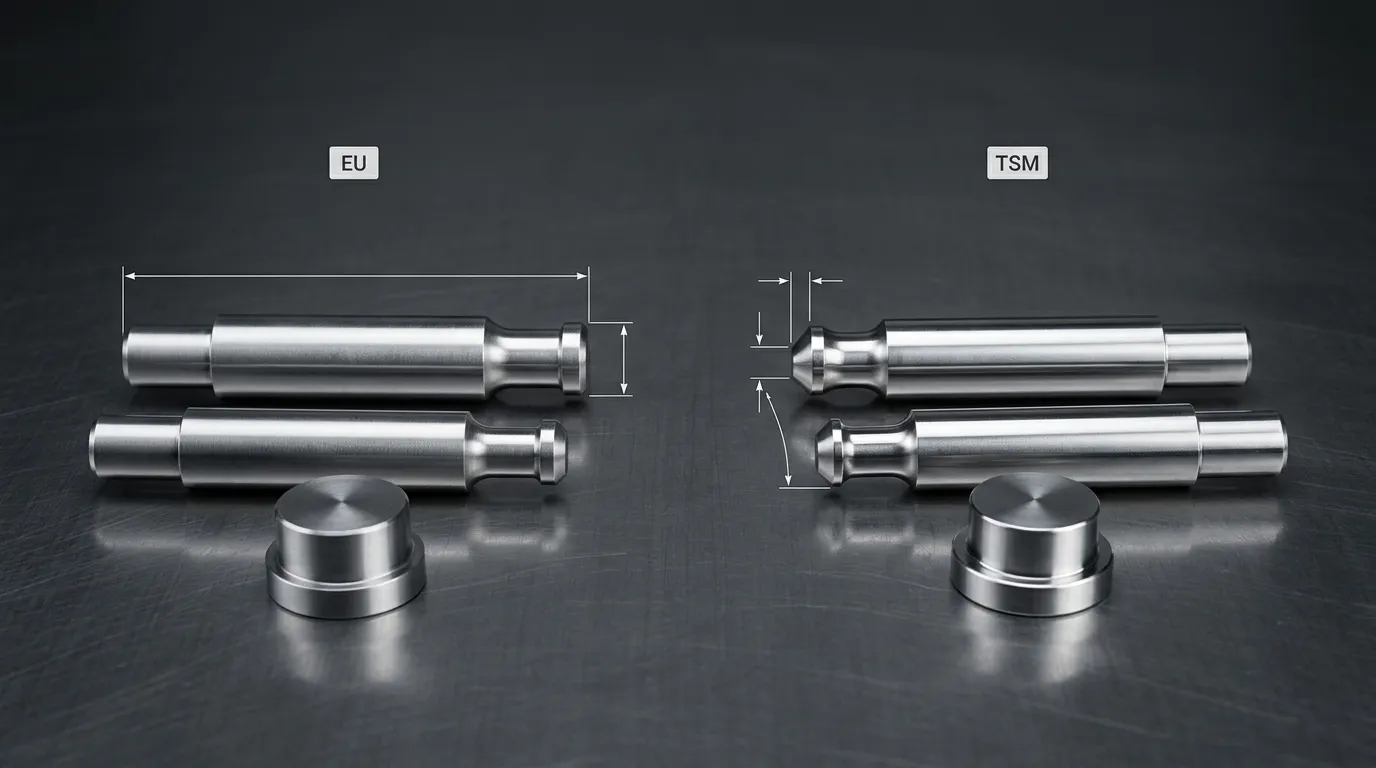
EU, Eurostandard, TSM, and ISO 18084: What the Terms Mean
TSM stands for Tableting Specification Manual. Published by the American Pharmacists Association, it establishes accepted terminology, drawings, dimensions, and specifications for tablet press punches and dies. The manual distinguishes measurements such as overall length, working length, head dimensions, die outside diameter, and die height. eBusiness Pharmacist+1
Eurostandard, sometimes called Euronorm, describes a tooling convention historically associated with European tablet presses. “EU tooling” is common industry shorthand, but the label alone does not prove that a tool conforms to a particular edition of an international standard.
ISO 18084:2011 is the formal international standard for tablet press punches and dies. ISO states that it covers their main dimensions, tolerances, characteristics, and measures relevant to punch interchangeability between machines from different manufacturers. The standard was published in 2011 and confirmed during its 2022 review. ISO
These terms are related, but they are not interchangeable claims:
| Term | What it identifies | What it does not prove |
|---|---|---|
| TSM | A tablet tooling specification manual and dimensional system | Compatibility with every press using B or D tooling |
| Eurostandard or Euronorm | A tooling convention associated with European press designs | Automatic conformity to ISO 18084 |
| ISO 18084 | An international standard covering punch and die dimensions, tolerances, and interchangeability measures | That a particular product complies without drawings or inspection evidence |
| EU tooling | Informal shorthand commonly used for Eurostandard tooling | European Union approval or legal compliance |
B and D Tooling Are Size Families, Not Compatibility Standards
B and D identify tooling size families. They describe important physical characteristics such as the nominal punch-barrel and die dimensions, but they do not fully define the punch.
A B-type TSM punch and a B-type Eurostandard punch may have broadly similar barrel proportions while differing in:
- Overall punch length
- Working length
- Head thickness
- Head profile
- Inner head or under-head angle
- Cam clearance
- Key position
- Die specification
The same principle applies to D tooling. A matching B or D label therefore answers only one part of the selection problem. It does not confirm that the tool will travel correctly through the press cams, contact the compression rollers properly, fit the die table, or maintain the required orientation.
EU vs TSM Tooling at a Glance
| Comparison factor | TSM tooling | EU or Eurostandard tooling | Compatibility meaning |
|---|---|---|---|
| Primary reference | Tableting Specification Manual | Eurostandard or Euronorm convention, often discussed alongside ISO 18084 | Confirm the exact drawing or standard edition |
| B and D families | Available within the TSM system | Available within the Eurostandard system | Matching family does not prove interchangeability |
| Overall punch length | Defined by the applicable TSM drawing | A different nominal length may apply | Length must match the press and turret |
| Traditional head profile | Many installed TSM tools use flat or angled heads; newer TSM guidance also favors domed heads | Commonly associated with a domed head profile | Never identify the system from head shape alone |
| Inner head geometry | TSM-specific geometry may apply | Eurostandard geometry may differ | Must match lifting and pull-down cams |
| Head thickness and dwell area | Controlled by the tooling specification | May use different dimensions or transitions | Influences roller contact and cam clearance |
| Die dimensions | Specified within the relevant TSM family | Correlated Eurostandard dimensions may differ | Verify outside diameter, height, groove, bore, and tolerances |
| Keying | Depends on punch shape and machine configuration | Also machine- and turret-dependent | Check key position, keying angle, and rotation |
| Direct interchangeability | Cannot be assumed | Cannot be assumed | Use press documentation and controlled drawings |
The official TSM material identifies overall punch length and inner head angle among the most significant differences between TSM and Eurostandard punches. It also notes correlated differences in B-type die specifications. eBusiness Pharmacist
The Dimensions and Interfaces That Actually Control Compatibility
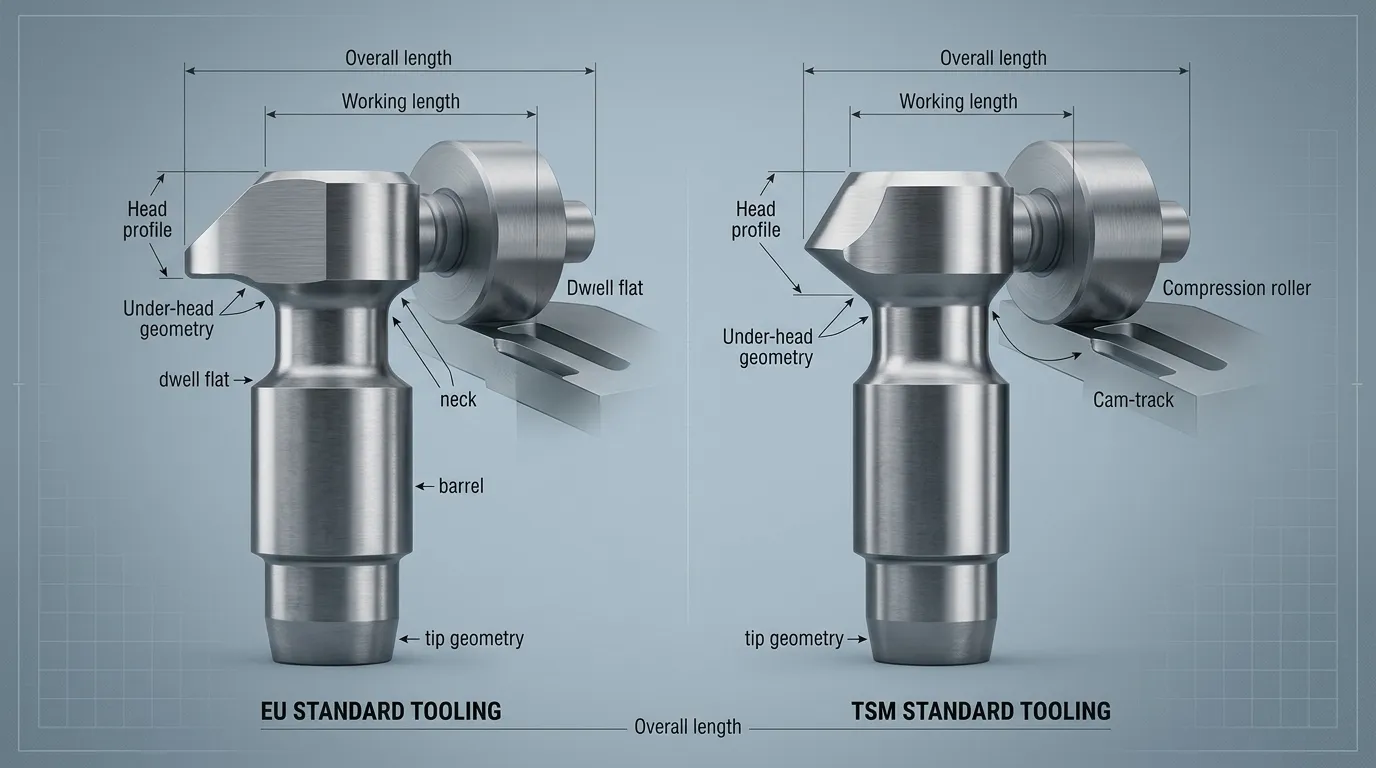
A tooling standard matters because the punch and die operate as part of a mechanical system. The punch head follows the cam track, contacts the compression roller, moves through the turret guide, and positions the tip inside the die bore. A mismatch at any one of these interfaces can make an apparently similar tool unsuitable.
Overall Length and Working Length Must Be Checked Separately
Overall length is the total distance from the punch head flat to the end of the tip. It affects how the punch fits and travels within the press and turret.
Working length is measured from the bottom of the punch cup to the head flat. It helps establish the operating relationship between the punch head and its working face. Upper- and lower-punch working lengths must be controlled as part of the tooling set. eBusiness Pharmacist+1
These measurements are not substitutes for each other. Two punches may share the same barrel family but have different overall or working lengths. That difference may change their installed position, cam relationship, or interaction with the opposing punch.
For replacement tooling, check the upper and lower punches separately. Do not calculate one component from an assumed standard unless the applicable drawing expressly permits it.
Head Profile, Thickness, and Cam Contact
The punch head is the interface between the tooling and several tablet press mechanisms. Its outside surface initially contacts the compression rollers, while the inner head area interacts with lifting or pull-down cams.
Traditional comparisons often describe TSM tooling as having a flat or angled head and Eurostandard tooling as having a domed head. That description is incomplete. The TSM manual notes that many existing flat-head TSM punches remain in use, but domed heads are preferred for new TSM punches. Head shape alone is therefore not a reliable identification method.
The features that require checking include:
- Outside head diameter
- Head thickness
- Head flat or dwell area
- Outside head angle or radius
- Inner head angle
- Neck and under-head geometry
- Clearance through the cam system
A technical paper on tooling standardization explains that variations in head profile, dwell flat, head thickness, head length, and under-head cam angle can restrict interchangeability between Eurostandard and TSM presses. I Holland Ltd+1
Upper Punch, Lower Punch, and Die Compatibility Are Separate Checks
A tablet tooling set normally contains an upper punch, a lower punch, and a die. These components work together, but they do not present identical compatibility questions.
The upper punch must match the upper guide, cam path, roller interface, working length, tip geometry, and any required keying.
The lower punch must match the lower guide and cam system while moving correctly within the die bore during filling, compression, and ejection. A broader explanation of their different operating roles belongs in upper punch vs lower punch tablet press.
The die requires its own dimensional review. The TSM manual defines die height and outside diameter in relation to the press die socket, while the die bore must correspond to the punch tip and intended tablet geometry. Matching punch-barrel sizes do not prove that die height, groove position, outside diameter, bore, or tolerances are compatible. eBusiness Pharmacist
Keying, Shaped Tooling, and Turret Rotation
Round punches may not require rotational control, but shaped and multi-tip upper punches normally need an anti-turn key. The key prevents rotation and maintains the relationship between the punch tip, die bore, ejection path, and take-off position.
The keying angle describes the relationship between the key and the punch-tip shape. Turret rotation also matters because the tablet must reach the take-off system in the correct orientation. Tooling-standardization research documents variations in keying angles and rotation among tablet press configurations, which means a keyed punch may fit the guide but still be incorrectly oriented for the machine. eBusiness Pharmacist+2I Holland Ltd+2
For shaped tooling, verify:
- Key type
- Key position on the barrel
- Keying angle relative to the punch tip
- Turret rotation direction
- Die orientation
- Tablet presentation at take-off
Can EU and TSM Tooling Be Used in the Same Tablet Press?
Sometimes a machine, turret, or tooling set has been designed or modified to accept a particular configuration. That possibility does not make EU and TSM tooling generally interchangeable.
| Situation | Can compatibility be assumed? | Required action |
|---|---|---|
| Both tools are labelled B | No | Compare the complete punch and die drawings |
| Barrel diameters match | No | Check length, head, tip, die, clearance, and keying |
| Overall lengths differ | No | Use the specification approved for the press and turret |
| Punches appear to match but the die is unverified | No | Inspect the die outside diameter, height, groove, bore, and tolerances |
| Round tooling has no key | No | Keying may be irrelevant, but all other interfaces still require verification |
| Shaped punches use different key positions | No | Confirm keying angle, turret rotation, and take-off orientation |
| The press has a conversion or replacement turret | Not without evidence | Obtain the conversion drawing and OEM or engineering approval |
| The press documentation specifies both configurations | Possibly | Follow the documented component and setup requirements |
A specialist technical paper states that differences in nominal punch length and under-head cam angles can prevent a Euro/ISO-length punch from being used directly in a TSM press, and vice versa. Treat this as the default caution unless machine-specific documentation establishes an approved alternative. I Holland Ltd+1
The correct standard is not the one that is universally “better.” It is the one that matches the press, turret, cams, dies, and controlled tooling drawing.
How to Identify the Required Tooling Standard Before Ordering
Identification should start with controlled documents, not visual comparison.
Check Documents and Machine Configuration First
Review the available information in this order:
- Tablet press manual and tooling specification
- Turret identification and drawing
- Existing upper-punch, lower-punch, and die drawings
- Drawing revision and approval history
- Previous tooling purchase records
- Conversion, retrofit, or replacement-turret records
- Tool markings and supplier identification
Record the exact press model and configuration. A manufacturer name or country of origin is not enough because tooling arrangements may differ between models, turrets, production sites, and later modifications.
Where the manual, drawing, and installed tooling disagree, stop the selection process. The conflict should be reviewed by the press manufacturer, tooling supplier, or qualified tooling engineer.
Measure the Existing Tooling When Drawings Are Missing
A physical sample can help reconstruct the specification, but measurement should use calibrated equipment and personnel familiar with tablet tooling. At minimum, collect:
- Upper- and lower-punch overall length
- Upper- and lower-punch working length
- Punch-barrel diameter
- Head outside diameter
- Head thickness
- Outside and inner head geometry
- Neck and under-head profile
- Tip diameter and tablet-face geometry
- Die outside diameter
- Die height and groove position
- Die-bore dimensions
- Key type, position, and angle
- Turret rotation direction
Measurement supports identification; it does not automatically prove conformity to TSM, Eurostandard, or ISO 18084. The results must still be compared with the governing drawing or specification.
What to Include in a Tablet Tooling RFQ or Supplier Review
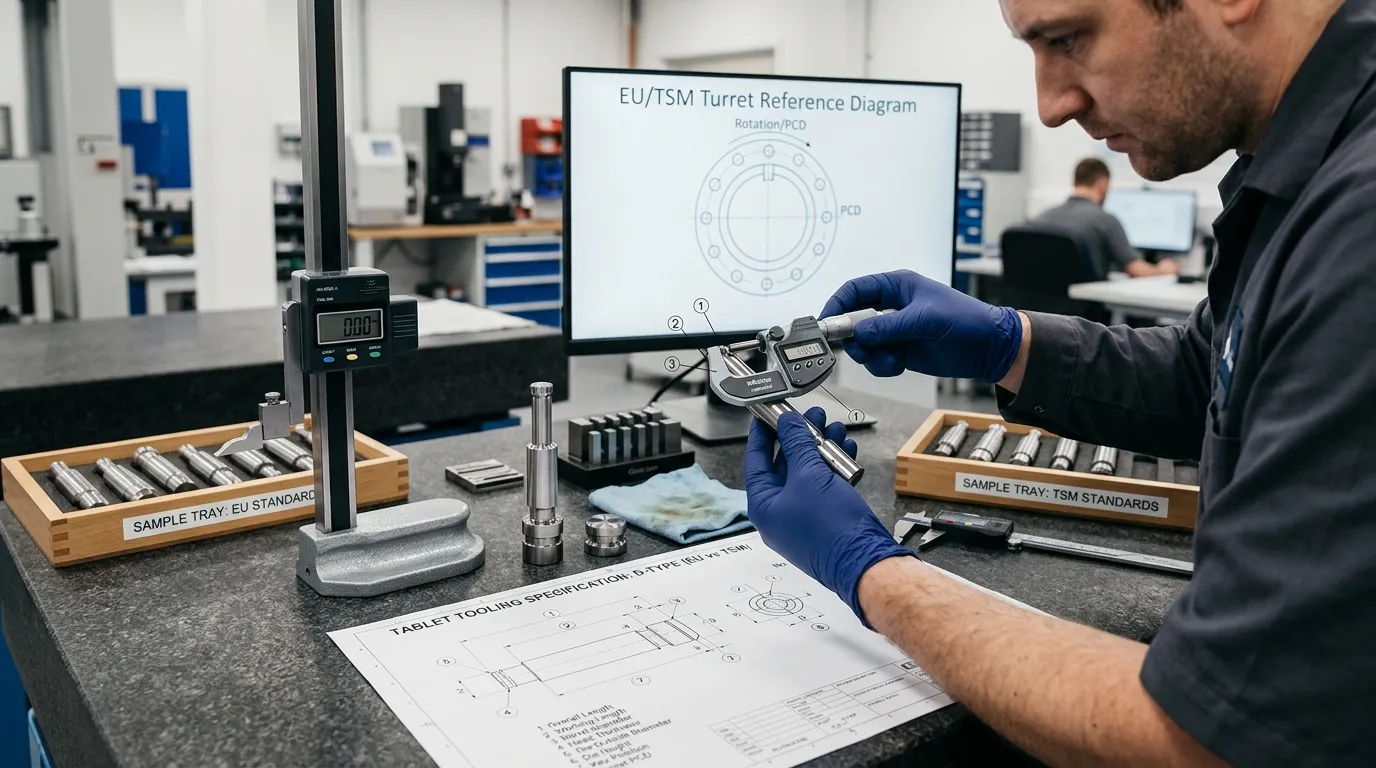
A supplier cannot confirm compatibility from “B tooling,” “D tooling,” or “EU tooling” alone. A useful request for quotation should include:
- Press manufacturer and exact model
- Turret type or drawing number
- Existing tooling family
- Required tooling standard, if confirmed
- Approved drawing and revision
- Upper-punch, lower-punch, and die specifications
- Overall and working lengths
- Head and under-head geometry
- Punch-tip and die-bore geometry
- Keying details and turret rotation
- Required material
- Inspection-report requirements
- A physical sample when controlled drawings are unavailable
- A request for dimensional review before production
SunshinePro’s tablet press tooling page lists punches and dies made from high-speed steel and states that custom processing can be based on drawings or samples. It also states that standard and non-standard sizes can be customized and that material inspection reports can be provided. These published capabilities do not, by themselves, establish TSM, Eurostandard, or ISO 18084 conformity for a specific tool. That must be confirmed through the approved specification, drawing, and inspection documentation. SunShinePro
Common Compatibility Mistakes to Avoid
- Treating B or D as a complete tooling specification
- Selecting tooling from the press’s country of origin
- Assuming one press brand always uses one standard
- Comparing only punch-barrel diameter
- Measuring overall length but not working length
- Checking the upper punch while ignoring the lower punch or die
- Identifying the standard from head shape alone
- Ignoring under-head and cam geometry
- Overlooking the keying angle on shaped punches
- Using an obsolete drawing revision
- Replacing one component without checking the complete tooling set
- Treating ISO 9001 certification as proof of ISO 18084 product conformity
The TSM manual warns that dimensional nonconformance can affect press operation and may reduce punch life or damage tooling and machinery. That is why compatibility should be demonstrated through controlled specifications rather than visual similarity. eBusiness Pharmacist
Frequently Asked Questions
Is Eurostandard tooling the same as ISO 18084 tooling?
Not automatically. Eurostandard tooling is commonly discussed in relation to ISO 18084, but a product label is not evidence of conformity. The supplier should identify the governing standard edition and provide dimensional documentation or inspection results for the specific tooling.
Does TSM tooling always have a flat or angled head?
No. Many traditional TSM punches use flat or angled heads, but the TSM material also identifies domed heads as preferred for new punches. Check the actual head drawing rather than identifying the standard from appearance. eBusiness Pharmacist
Can a tablet press be converted from TSM to Eurostandard tooling?
A conversion may be possible for a particular machine or turret, but it requires press-specific engineering. Confirm the replacement turret, cams, punch guides, die table, keying, and approved tooling drawings with the press manufacturer or qualified engineering provider.
Does ISO 9001 certification prove compliance with ISO 18084?
No. ISO 9001 concerns a quality management system, while ISO 18084 contains product-related dimensions and characteristics for tablet punches and dies. ISO also explains that it develops standards but does not itself certify companies or issue certificates. ISO
Before ordering, assemble the press model, turret information, approved drawings, component measurements, and keying details. For a tooling review based on drawings or physical samples, contact SunshinePro with the available technical information rather than relying only on an EU, TSM, B, or D label.
Share:


Written By Tonmoy
NEWS
GET SERVICE
With quality parts to meet every budget and friendly staff trained to make your visit informative and hassle free.
