



B Tooling vs D Tooling: Dimensions, Capacity, and Compatibility
B tooling and D tooling are dimensional families of tablet press punches and dies. B tooling has a smaller punch barrel and die envelope, which can allow more stations on a given turret. D tooling is physically larger and commonly accommodates a larger tablet envelope and different dwell configurations.
Neither is universally better. The correct choice depends on the installed press and turret, tablet geometry, formulation behaviour, required dwell and compression conditions, tooling standard, and production target. For broader context on B, D, BB, and DB configurations, see tablet press tooling types.
“Capacity” also needs a clear definition. In a B tooling vs D tooling comparison, it can refer to:
- The size of tablet the tooling can accommodate;
- the number of stations and potential production output;
- the compression and dwell conditions available to form an acceptable tablet.
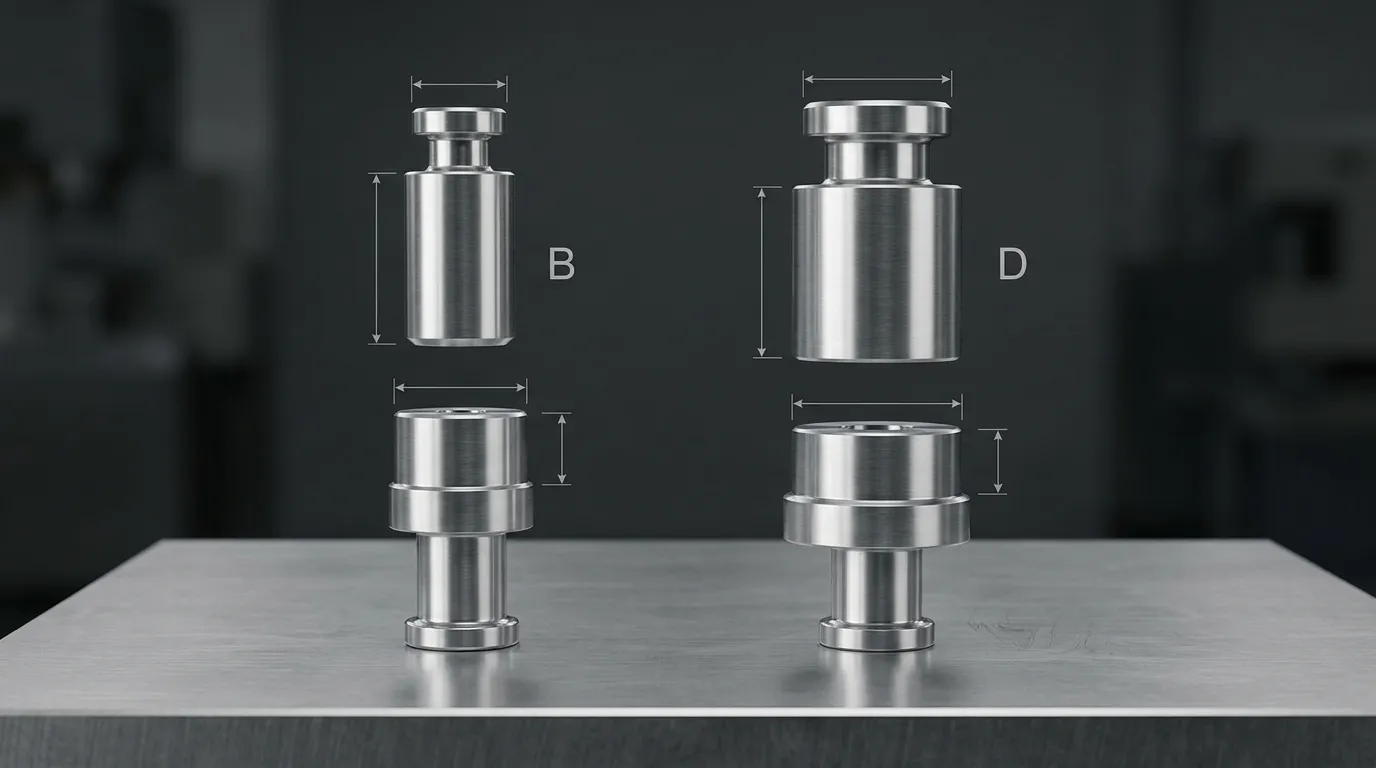
B Tooling and D Tooling Compared at a Glance
| Comparison criterion | B tooling | D tooling |
|---|---|---|
| Nominal punch-barrel diameter | About 19 mm | About 25.35 mm |
| Nominal punch-head outside diameter | About 25.27 mm | About 31.6 mm |
| Common die outside diameter | About 30.16 mm | About 38.10 mm |
| Common die height | About 22.22 mm | About 23.81 mm |
| Common maximum round-tablet reference | Up to about 16 mm | Up to about 25 mm |
| Turret station-density tendency | Higher, where the turret is designed for B tooling | Lower than a comparable B turret because each station needs more space |
| Dwell tendency | Depends on head form, press geometry, and speed | Often associated with a larger head-flat or longer dwell opportunity, but not universally |
| Typical selection direction | Smaller tablet envelope or greater station density | Larger tablet envelope or a process needing a different head and dwell configuration |
| Direct interchangeability | No | No |
These are common reference dimensions, not a complete purchase specification. ISO 18084 defines principal punch-and-die dimensions, tolerances, characteristics, and interchangeability-related measures. A KORSCH technical paper also lists 19 mm and 25 mm nominal punch barrels, with 30.16 mm and 38.10 mm die diameters for B and D configurations respectively. The approved tooling and turret drawings must control the final order. Tepha+4Itech Standards+4Itech Standards+4
Dimensional Differences That Determine Tooling Fit
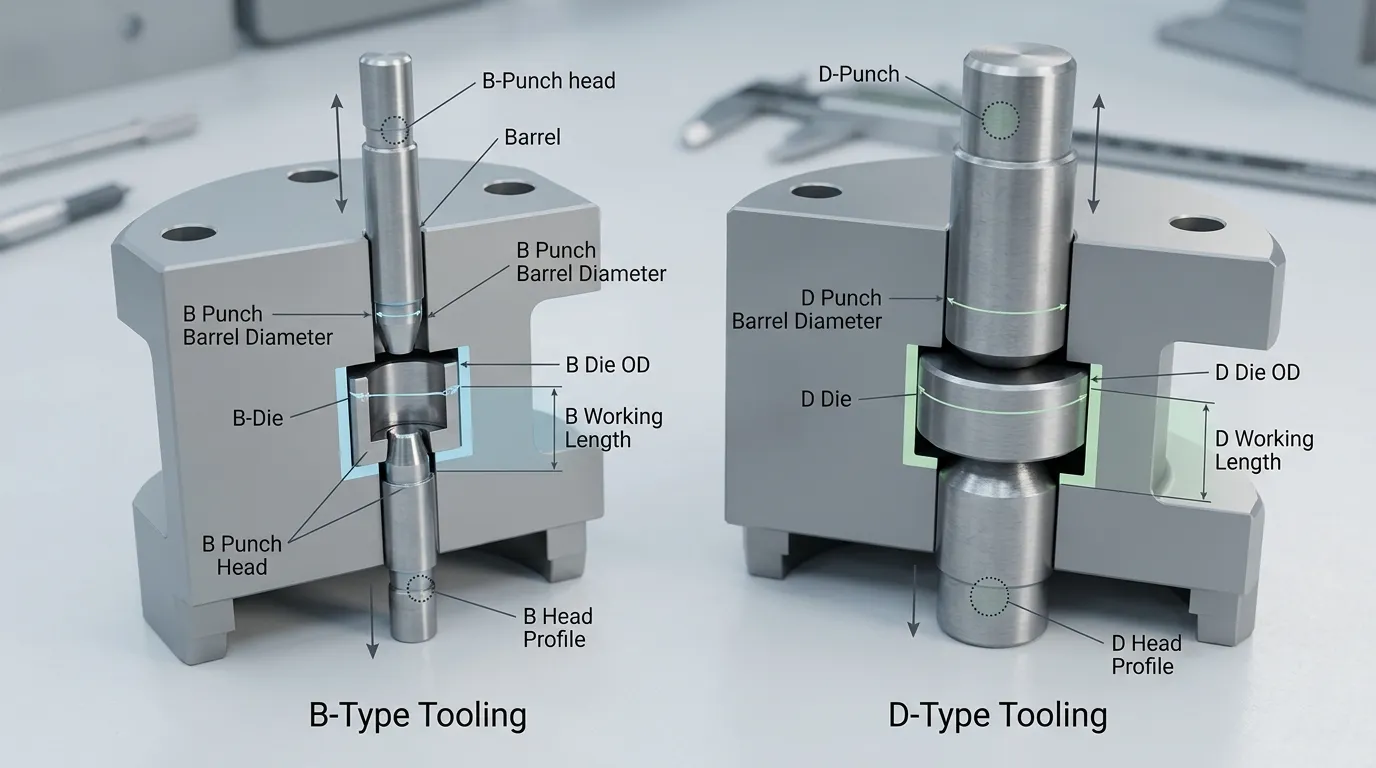
The visible size difference between B and D tooling is not merely a capacity preference. It determines whether the components can physically run in a particular turret.
A punch barrel travels through a precisely sized punch guide. A B punch with a nominal barrel near 19 mm cannot simply replace a D punch designed for a guide near 25.35 mm. The same restriction applies to dies: a common B die outside diameter is approximately 30.16 mm, while a common D die is approximately 38.10 mm. The turret die pockets and retention system must match those dimensions. Itech Standards+1
Punch-head geometry also matters. The head contacts the tablet press cams and compression rollers, so its diameter, thickness, radius, flat, and under-head geometry influence how the punch travels through the compression cycle. Two punches can share a B or D designation and still be incompatible because they follow different standards or machine-specific designs.
Punch and Die Dimensions That Must Match
A supplier normally needs more than the words “B tooling” or “D tooling.” The critical dimensions and features include:
- Upper- and lower-punch barrel diameter;
- punch-head outside diameter and profile;
- upper- and lower-punch overall length;
- working length;
- punch-tip dimensions and cup depth;
- die outside diameter and height;
- die-bore dimensions;
- die groove, taper, or retention features;
- anti-turn key location and angle;
- tablet press turret rotation.
Working length is especially important because variation within a tooling set can affect the final tablet thickness and consistency. Overall length, barrel diameter, die OD, die bore, and head form are also treated as critical inspection dimensions in established tooling-management guidance. I Holland Ltd
Why a Nominal B or D Label Does Not Guarantee Interchangeability
B and D describe tooling-size families. They do not, by themselves, confirm the complete standard.
Euro/ISO and TSM configurations may differ in punch-head form, head flat, head thickness, under-head cam angle, nominal overall length, and keying. Those differences can restrict interchangeability even when both tools are described as B tooling or both as D tooling. Shaped and multi-tip upper punches also require the correct anti-turn key position for the turret’s rotation and tablet take-off arrangement. I Holland Ltd
What “Capacity” Means in a B-versus-D Comparison
Tooling capacity should be evaluated in three separate categories. A family that offers more tablet-size capacity does not automatically provide more production capacity, and a larger tool does not establish a universal safe compression-force rating.
Tablet-Size Capacity
D tooling provides a larger physical envelope for the punch tip and die bore. A common industry reference is approximately 25 mm for a round tablet under D tooling and approximately 16 mm under B tooling. These figures are useful for preliminary screening, but they are not universal design limits. KORSCH+1
The supplier must also consider:
- Major and minor tablet dimensions;
- round or shaped profile;
- cup depth;
- edge land and web thickness;
- score-line geometry;
- embossing;
- tablet thickness and target weight;
- punch-tip strength;
- clearance between the tip and die bore.
A shaped, scored, embossed, or multilayer tablet does not inherently require D tooling. Those features depend on tablet design, punch-tip geometry, keying, machine capability, and mechanical loading. The B-or-D decision concerns the available tooling envelope and press configuration, not whether the tablet face is simple or complex.
Production Capacity and Turret Station Density
Because B tooling uses a smaller barrel and die envelope, a turret of a given pitch-circle size can often accommodate more B stations than D stations. More stations can increase theoretical output when the press runs at the same speed.
For a single-tip, single-sided press, the basic relationship is:
Theoretical tablets per hour = turret speed in revolutions per minute × number of stations × 60
For multi-tip tooling, multiply the result by the number of tablet tips at each station. KORSCH uses this relationship in its technical discussion of turret selection and multi-tip production. KORSCH
That does not mean B tooling guarantees higher real production. Actual validated output also depends on:
- Maximum sustainable turret speed;
- formulation flow and die filling;
- compression dwell requirements;
- feeder performance;
- tablet weight-control capability;
- ejection and take-off behaviour;
- tooling condition;
- rejection and inspection requirements;
- single-tip or multi-tip configuration.
A difficult-to-compress formulation may require slower operation. In that case, the station-count advantage can be partly or completely offset by the lower sustainable speed.
Compression Force and Dwell Capability
Dwell time is the period during which the punch tips remain at or near the minimum separation under compression. It is influenced by punch-head geometry, head-flat size, compression-roller geometry, turret pitch-circle velocity, and press speed.
D tooling is often associated with a larger head geometry and longer dwell opportunity, but the relationship is not absolute. Both B and D tools can use modified or extended head flats, and the exact result depends on the selected standard and press.
A peer-reviewed study comparing B and D tooling found that head-flat diameter and tooling type affected tablet mechanical properties, but the results also changed with formulation composition and compression force. The study therefore supports a formulation-dependent decision—not the claim that D tooling always produces stronger tablets. Research on B/D tooling and punch-head geometry reported interactions among tooling type, dwell, force, tensile strength, friability, and capping behaviour. ResearchGate+2Taylor & Francis Online+2
Natoli’s technical guidance similarly explains that increasing the punch-head flat can lengthen dwell at the same turret speed for both TSM-B and TSM-D tools. Formulation strain-rate sensitivity can determine whether that additional dwell improves production performance. Natoli Engineering
A safe maximum force cannot be selected from the B or D label alone. It also depends on the press rating, punch-tip area and shape, tool material, heat treatment, head design, tool condition, formulation, and approved engineering calculations.
Compatibility Requires More Than Choosing B or D
A correct tooling order must satisfy several compatibility layers:
- Tooling family: B or D;
- tooling standard: EU/ISO, TSM, or another machine-specific specification;
- turret geometry: punch guides, die pockets, station layout, and retention;
- punch geometry: head form, lengths, working length, and keying;
- tablet geometry: tip, cup, score, embossing, land, and die bore;
- process requirements: fill depth, force, dwell, ejection, and output.
Tooling Family and Tooling Standard Are Different Decisions
B tooling is not synonymous with TSM tooling, and D tooling is not synonymous with European tooling. Both B and D families may be configured under TSM or EU/ISO conventions.
The standard adds dimensional details beyond the barrel and die envelope. Differences in overall length, head form, under-head angle, and keying can prevent a tool from running correctly in another press. For a dedicated treatment of that second compatibility layer, see EU vs TSM tablet tooling standards. I Holland Ltd
Press and Turret Details to Verify
Before approving either family, confirm:
- Tablet press manufacturer and model;
- turret model, drawing, or identification number;
- number of turret stations;
- B or D punch-guide size;
- die-pocket diameter, height, and retention design;
- upper- and lower-punch overall lengths;
- tooling working length;
- punch-head profile and under-head geometry;
- tooling standard;
- key location and key angle;
- clockwise or anticlockwise turret rotation;
- existing tooling drawing or physical reference sample.
A machine advertised as supporting several tooling families may use exchangeable turrets or another purpose-designed arrangement. That does not make ordinary B and D components interchangeable within one fixed turret.
How to Choose Between B and D Tooling
The existing tablet press and turret should be the first selection constraint. If the machine already uses a fixed B or D turret, changing the tooling family may require a replacement turret or more extensive machine engineering.
| Requirement | B tooling may be the better starting point | D tooling may be the better starting point |
|---|---|---|
| Installed equipment | Press and turret are designed for B tooling | Press and turret are designed for D tooling |
| Tablet geometry | Tablet fits comfortably within the verified B-tool envelope | Tablet requires the larger verified D-tool envelope |
| Production priority | Greater station density is valuable | Required output can be achieved with the available D station count |
| Formulation behaviour | Acceptable tablet quality is achieved within the available dwell | Formulation benefits from the selected D head and dwell configuration |
| Compression requirement | Force and tip-strength calculations are acceptable for the proposed B tool | Proposed tablet and process require a larger tool envelope, subject to engineering verification |
| Compatibility status | B family, standard, lengths, die, and keying are confirmed | D family, standard, lengths, die, and keying are confirmed |
B Tooling Is Usually the Better Starting Point When
Consider B tooling when the press already has a compatible B turret, the tablet fits within its verified design envelope, and higher station density offers a useful production advantage. The formulation must still achieve the required tablet properties at the press speed and dwell available.
D Tooling Is Usually the Better Starting Point When
Consider D tooling when the press has a compatible D turret, the tablet requires a larger tip and die envelope, or the selected head geometry provides a more suitable compression window. The process must still meet its output target with the available station count and operating speed.
Stop and Verify Before Choosing Either
Do not choose from a generic size chart alone when:
- The tooling standard is unknown;
- the turret drawing is unavailable;
- the tablet is close to the assumed size limit;
- unusually high force or long dwell is required;
- shaped or multi-tip tooling needs precise key orientation;
- a replacement tool must match an existing set;
- a B-to-D or D-to-B conversion is being considered;
- the press contains proprietary or modified tooling geometry.
Common B-versus-D Tooling Misconceptions
| Misconception | More accurate interpretation |
|---|---|
| D tooling is European tooling. | D is a tooling-size family. EU/ISO and TSM are separate standards layers. |
| B tooling always produces more tablets. | It can allow more stations, but real output also depends on speed, dwell, feeding, formulation, tips per punch, and validation requirements. |
| D tooling always handles more force. | Safe force depends on the press, head and tip geometry, tool material, tablet area, formulation, and engineering calculations. |
| Only D tooling can produce shaped, scored, embossed, or multilayer tablets. | These features depend on the punch-tip design, keying, tablet geometry, and machine capability. |
| Any B tool fits any B press. | Overall length, head form, under-head angle, die details, keying, and machine-specific geometry may differ. |
| The published maximum tablet diameter is a guaranteed limit. | It is a preliminary reference. The proposed design still needs mechanical and press-specific review. |
| Changing punches and dies converts a B press to D. | A different turret or machine configuration is normally required because punch guides and die pockets are different. |
What to Include in a B or D Tooling RFQ
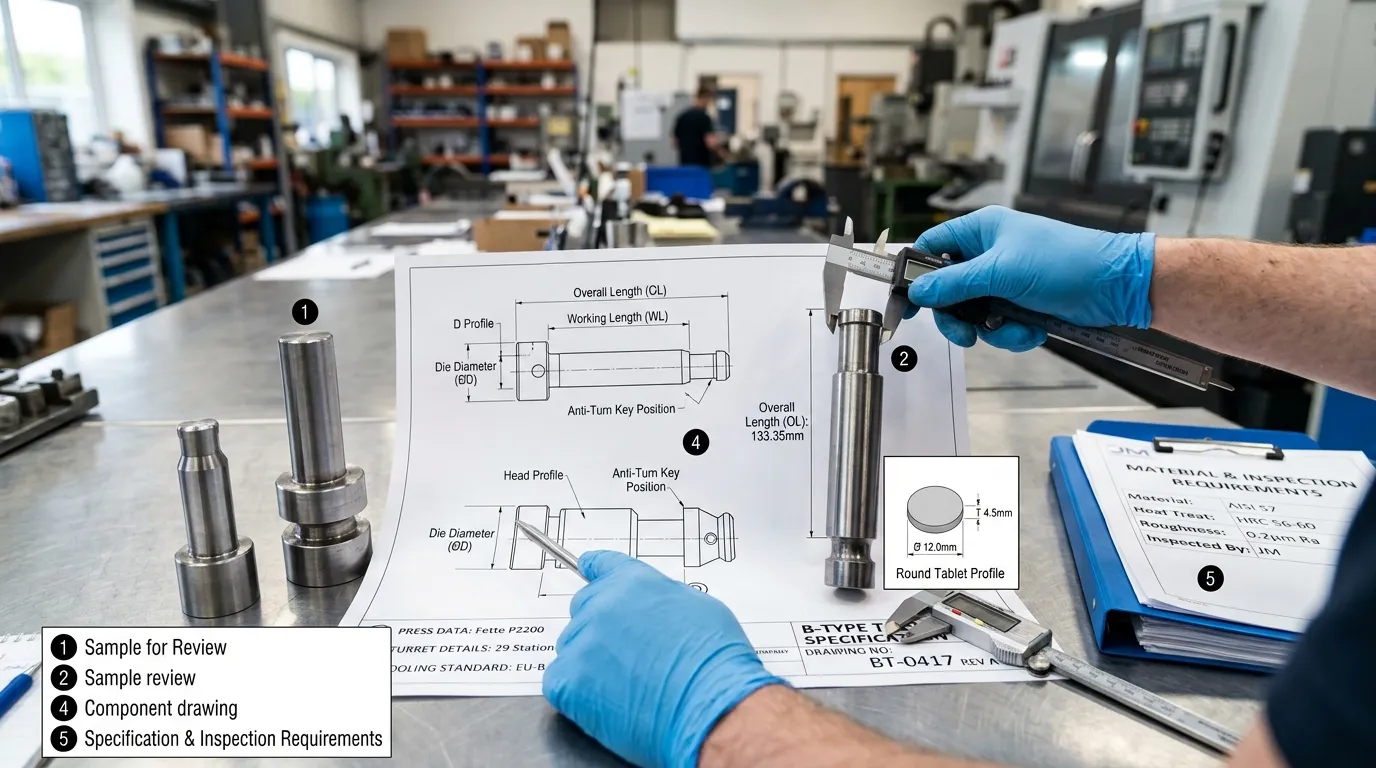
A useful tooling enquiry should contain enough information for dimensional and process review. Include:
- Tablet press manufacturer and model;
- turret designation and station count;
- required B or D family;
- EU/ISO, TSM, or machine-specific standard;
- upper- and lower-punch drawings;
- die drawing;
- overall and working lengths;
- punch-head and under-head geometry;
- die OD, height, bore, groove, and retention;
- anti-turn key location and turret rotation;
- tablet drawing with all major dimensions;
- cup, score, embossing, land, and tolerance details;
- tablet weight and thickness targets;
- formulation concerns such as abrasion, corrosion, or sticking;
- required tool material, heat treatment, or coating;
- dimensional inspection and material-documentation requirements;
- an existing sample when an approved drawing is unavailable.
SunshinePro’s tablet press tooling page states that it supplies tablet press punches and dies, lists high-speed steel, CNC machining, heat treatment, and customization from drawings or samples, and says material inspection reports can be provided. These verified statements support a drawing-led enquiry, but the required B or D family, standard, dimensions, material, and tolerance scope should be confirmed for the specific order. SunShinePro
Final Selection Principle: Match the Tooling to the Press, Tablet, and Process
Choose B or D tooling by working in this order:
- Confirm the installed press, turret, and tooling standard.
- Verify that the tablet geometry fits the available tooling envelope.
- Check the formulation’s dwell and compression requirements.
- evaluate output using the actual station count and sustainable press speed.
- Control the final order with approved tooling and tablet drawings.
For a custom or replacement requirement, prepare the press data, turret details, drawings, standard, key orientation, and existing sample where applicable. Then contact SunshinePro for a specification and manufacturing review rather than relying on the B or D designation alone.
Share:


Written By Tonmoy
NEWS
GET SERVICE
With quality parts to meet every budget and friendly staff trained to make your visit informative and hassle free.
