



TiN vs DLC Coating for Punch Pins: Friction, Wear, and Cost
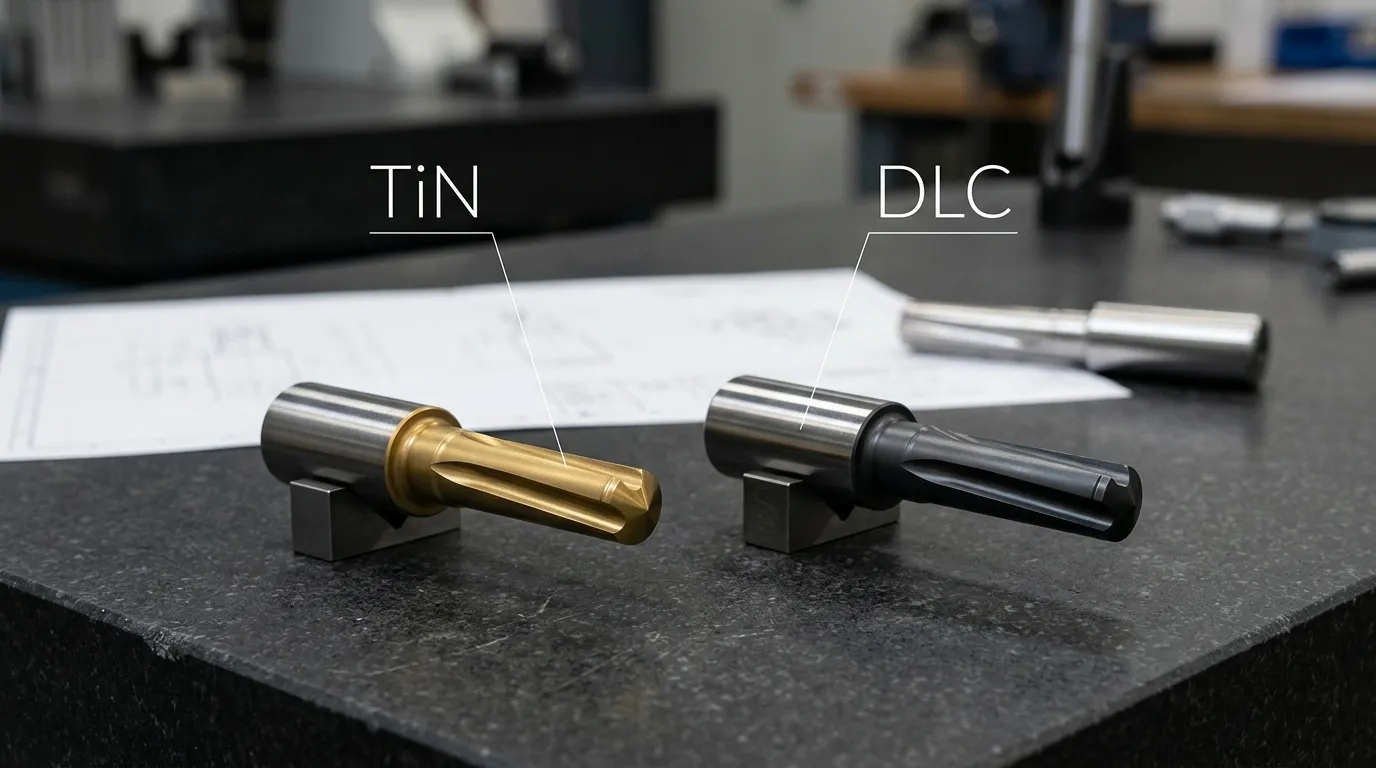
Neither coating is automatically better. The correct choice depends on the punch substrate, workpiece material, lubrication, die clearance, impact loading, surface preparation, and the exact coating system being offered. Coating is also only one part of the tooling decision; the broader relationship between punch material, die design, clearance, and maintenance is covered in this punching dies guide (inferred).
TiN vs DLC for Punch Pins: The Practical Answer
The most useful comparison begins with the punch’s actual failure mode rather than one hardness or friction figure.
| Comparison factor | TiN | DLC |
|---|---|---|
| Coating category | Titanium nitride ceramic coating | Family of carbon-based coatings |
| Main reason to consider it | General wear protection and a proven hard surface | Low friction, anti-stick behavior, and adhesive-wear control |
| Friction tendency | Usually higher than many DLC systems | Often lower, depending on the DLC type and test conditions |
| Abrasive wear | Commonly used where hard-surface wear resistance is important | Can also resist abrasion, but performance varies significantly by DLC formulation |
| Galling and material pickup | May reduce wear but is not normally the first choice when severe sticking dominates | Often considered when galling, pickup, or sliding friction is the main problem |
| Impact sensitivity | Depends on coating thickness, adhesion, and substrate support | Can be sensitive to impact, residual stress, and substrate deformation, depending on the DLC structure |
| Workpiece fit | Often used as a general-purpose option for punching and forming metals | Frequently evaluated for aluminum, copper, stainless steel, coated sheet, and other pickup-prone applications |
| Specification clarity | TiN is a more clearly defined coating category | “DLC” alone is not a complete technical specification |
| Relative upfront cost | Often the lower-cost baseline | Commonly more expensive, but the premium depends on the exact film and process |
| Best preliminary fit | Broad wear protection with controlled cost | Low-friction or anti-galling applications where pickup drives downtime or scrap |
Published values should not be compared without context. A friction coefficient measured against steel under dry laboratory conditions is not directly equivalent to a value measured against another material, under lubrication, or with a different load. The same caution applies to hardness and wear results.
Why DLC Cannot Be Treated as One Coating
TiN refers to a recognizable titanium nitride coating system. DLC, or diamond-like carbon, is a broad family of carbon-based films.
The ISO 20523 classification for carbon-based films exists because these coatings can differ in carbon bonding, hydrogen content, alloying elements, layer structure, and deposition method. Common examples include:
-
a-C:H: a hydrogenated amorphous carbon coating.
-
ta-C: a non-hydrogenated, high-sp³ carbon coating.
-
Si-DLC or DLC:Si: a silicon-modified DLC system.
-
Multilayer DLC: a coating built with transition layers or interlayers to manage stress and adhesion.
These differences affect friction, hardness, residual stress, coating thickness, temperature capability, adhesion, and impact behavior. Two suppliers may both quote “DLC” while offering materially different systems.
A useful DLC quotation should therefore identify:
-
The exact coating designation.
-
Whether the film is hydrogenated or non-hydrogenated.
-
The deposition method, such as PVD or PACVD.
-
Any interlayer or pretreatment.
-
Coating thickness.
-
Processing temperature.
-
Substrate requirements.
-
The conditions used to measure friction, hardness, and adhesion.
Technical pages from coating companies such as Ionbond also describe DLC as a configurable family rather than one fixed material. Their published data apply to their own coating systems and should not be treated as universal values.
Friction and Wear Mode Matter More Than a Single Hardness Number
A punch pin experiences several forms of contact during each stroke. The punch face enters the sheet, the cutting edge performs the shearing action, and the punch flank slides against the cut material during penetration and withdrawal.
That means a coating must do more than test well in a simple hardness comparison. It must remain attached to the substrate, tolerate repeated loading, and resist the actual wear mechanism occurring in production.
The ASTM G99 wear and friction test method makes clear that friction and wear results depend on variables such as load, speed, materials, environment, and test configuration. A published coefficient is useful only when the counterface and conditions are known.
Abrasive Wear: When a Hard Wear-Resistant Surface Is the Priority
Abrasive wear occurs when hard particles, scale, debris, or the workpiece surface gradually removes material from the punch. Typical signs include flank scratches, edge rounding, progressive dimensional loss, and increased burr formation.
TiN is commonly used as a practical hard-coating baseline for tools where general wear resistance is the main requirement. A manufacturer such as voestalpine eifeler lists TiN for punching and forming applications, but its published hardness, friction, and temperature data describe its own TiN system rather than every TiN coating.
A DLC system may also provide strong wear resistance, but “DLC” does not tell the buyer enough. The result depends on the film structure, thickness, adhesion, interlayer, and substrate.
For abrasive-wear applications, evaluate:
-
Coating hardness.
-
Adhesion to the punch material.
-
Surface finish before coating.
-
Thickness around the cutting edge.
-
Substrate hardness and toughness.
-
Debris and contamination in the stamping process.
-
Whether the workpiece has a hard surface layer or coating.
Hardness helps, but it is not a standalone predictor of tool life. A hard coating can still crack or detach if the substrate deforms beneath it.
Adhesive Wear and Galling: When Low Friction Becomes More Important
Adhesive wear occurs when workpiece material transfers to the punch surface. The transferred material creates rough high spots, raises friction, changes the local cutting condition, and may damage the workpiece surface.
This is the condition in which DLC often becomes more attractive. Suitable DLC systems can provide low-friction and anti-stick behavior, especially where aluminum, copper, stainless steel, or coated sheet tends to adhere to the punch.
Research on DLC-coated tools in aluminum forming has shown strong anti-galling behavior under the tested conditions. That evidence supports DLC as a serious option, but it does not prove that every DLC film will eliminate galling in every punch application.
TiN may still be sufficient where pickup is moderate, lubrication is effective, and a proven TiN process already exists. The choice should also account for polishing, clearance, lubricant compatibility, stripping force, and workpiece surface condition.
For the broader diagnosis and control of transferred material, lubrication, finish, and process conditions, see punch pin galling prevention.
Which Coating Fits Different Punching Applications?
Workpiece material is a useful starting point, but it should not be the only selection rule. Two grades of stainless steel, for example, can behave differently because of hardness, surface finish, thickness, lubrication, and production speed.
| Application condition | Preliminary direction | Why | Main caution |
| Carbon or low-alloy steel with gradual flank wear | Consider TiN first | Established hard-surface option for general wear control | Check debris, scale, clearance, and substrate support |
| Stainless steel with pickup or galling | Consider a specified DLC system | Lower friction may reduce adhesive transfer | Impact, film adhesion, and lubrication still require review |
| Aluminum sheet with material buildup | DLC often deserves priority evaluation | Anti-stick behavior may reduce pickup and surface damage | Confirm the exact DLC type and test it under production conditions |
| Copper or copper-alloy sheet with transfer marks | Consider DLC or test both | Low-friction behavior may help control adhesion | Surface quality and lubricant interaction can change the result |
| Galvanized or pre-painted sheet | Select by observed wear and surface-transfer behavior | The sheet coating can create debris, transfer, or surface-damage concerns | Do not assume the same answer for every coated sheet |
| Hard or abrasive sheet with limited pickup | Consider TiN or a wear-focused DLC system | Abrasion may matter more than friction | Compare coating adhesion and edge durability, not hardness alone |
| Dry stamping with severe sliding friction | DLC may justify evaluation | Low friction can reduce sticking and stripping resistance | Dry impact conditions may increase coating stress |
| Lubricated process with stable wear | TiN may provide adequate value | The lubricant may already control adhesive wear | Verify lubricant compatibility and actual maintenance intervals |
| Mixed abrasive wear, pickup, and chipping | Test both | No single general property predicts the result | Fix clearance, alignment, and substrate problems before testing |
Sunshine lists TiN and DLC as optional coatings for custom punch pins. That confirms both options are relevant to its punch-pin offering, but it does not establish that one option is correct for every listed material or application.
When a Controlled A/B Production Trial Is the Safer Decision
A production trial is appropriate when:
-
The punch shows both abrasive wear and material pickup.
-
The DLC specification is unclear or differs between suppliers.
-
Downtime or rejected parts create a high cost.
-
The workpiece has an unusual coating or surface treatment.
-
Impact or delamination risk is uncertain.
-
Supplier friction data were measured under different conditions.
-
The operation will be standardized across a high-volume production line.
The TiN-coated and DLC-coated punches should be compared under the same press, workpiece, clearance, lubrication, and inspection conditions. Useful measurements include:
-
Strokes until a defined failure point.
-
Material buildup on the flank.
-
Burr growth.
-
Dimensional drift.
-
Workpiece surface damage.
-
Cleaning frequency.
-
Regrinding frequency.
-
Unplanned press stoppages.
The failure criteria should be set before testing. Otherwise, the result can be influenced by subjective inspection or inconsistent maintenance decisions.
What TiN and DLC Cannot Fix
A surface coating cannot compensate for a structurally unsuitable punch or a poorly controlled die system.
Early wear, cracking, or delamination may be caused by:
-
Incorrect punch-to-die clearance.
-
Punch and die misalignment.
-
Inadequate substrate hardness.
-
Insufficient substrate toughness.
-
Poor heat treatment.
-
Rough grinding marks.
-
A damaged or excessively sharp edge.
-
Side loading.
-
Excessive impact.
-
Inadequate lubrication.
-
Poor coating adhesion.
-
Excessive residual stress.
-
An unsuitable coating thickness.
If the substrate deforms, the coating must follow that deformation. A hard film may then crack, detach, or fail at the interface. Research on coated stamping tools and cyclic impact shows why adhesion, layer structure, substrate condition, and repeated loading must be evaluated together rather than separately.
The surrounding guide components and alignment system also affect punch loading. The die components guide provides broader context on how punches, pins, bushings, and guide parts interact.
Coatings should also not be treated as a solution for every structural failure. For misalignment, overload, insufficient toughness, and other fracture-related causes, refer to punch breakage in stamping dies.
TiN vs DLC Cost: Compare More Than the Coating Price
TiN is often treated as the lower-cost, familiar baseline. DLC commonly carries a higher initial expense because the process may involve a specialized film structure, interlayer, additional preparation, or stricter process control.
There is no reliable universal price ratio. Cost changes with:
-
Punch size and geometry.
-
Batch quantity.
-
Surface preparation.
-
Masking requirements.
-
Coating thickness.
-
DLC type.
-
Interlayer design.
-
Stripping of an old coating.
-
Regrinding.
-
Inspection requirements.
-
Transport between manufacturing and coating facilities.
The more useful comparison is total tooling cost.
| Cost factor | Why it matters |
| Initial coating expense | Determines the immediate purchase difference |
| Surface preparation | Polishing or corrective finishing may be required |
| Service interval | Longer stable operation may reduce tool changes |
| Cleaning frequency | Material pickup can require repeated cleaning |
| Scrap | Pickup, burr growth, or surface damage can reject parts |
| Press downtime | Tool removal and replacement interrupt production |
| Regrinding | Restores geometry but affects coating and dimensions |
| Stripping and recoating | Adds process steps and may limit how often the punch can be restored |
| Inspection | Critical dimensions may need verification after coating or recoating |
A practical comparison is:
Total coating, maintenance, downtime, and scrap cost ÷ acceptable production strokes
DLC is worth the additional expense only when the reduction in pickup, maintenance, scrap, or downtime exceeds the added coating cost. TiN remains the better value when it provides stable wear control without creating those production losses.
What to Confirm Before Ordering a Coated Punch Pin
A useful coating recommendation requires more than a drawing and the words “TiN” or “DLC.”
Ask the supplier to confirm:
-
Exact coating designation.
-
DLC subtype, if applicable.
-
Deposition method.
-
Interlayer or pretreatment.
-
Coating thickness and variation.
-
Processing temperature.
-
Compatible substrate materials and hardness.
-
Required surface finish.
-
Cutting-edge preparation.
-
Friction test method and counterface.
-
Lubricated or dry test condition.
-
Hardness test method.
-
Adhesion or scratch-test information.
-
Areas that require masking.
-
Whether critical dimensions are inspected after coating.
-
Coating-removal process.
-
Regrinding and recoating policy.
Provide the supplier with:
-
Punch drawing.
-
Critical tolerances.
-
Punch material and hardness.
-
Workpiece alloy.
-
Workpiece thickness.
-
Workpiece surface coating.
-
Punch-to-die clearance.
-
Press speed or stroke conditions.
-
Lubrication details.
-
Current coating, if any.
-
Observed failure mode.
-
Current service interval.
-
Photographs of flank wear, chipping, or material pickup.
Sunshine states that custom punch pins can be produced from drawings, samples, or technical specifications. Its custom punch pin page lists SKH51, SKH9, DC53, ASP steel, and carbide, along with TiN and DLC as optional coatings. The website also lists CNC machining, EDM, grinding, and heat treatment for these parts.
Those listings support a technical discussion about a custom coated punch. They do not, by themselves, establish the exact DLC subtype, coating process, post-coating tolerance, or coating-specific test method. These details should be confirmed for the individual quotation.
Final Selection Guide
| Consider TiN first when | Consider a specified DLC system when | Test both when |
| General wear protection is the main goal | Galling or material pickup controls tool life | Abrasive and adhesive wear occur together |
| Abrasive flank wear is more important than sticking | Low friction is a high priority | Impact or delamination risk is unclear |
| Initial coating cost matters strongly | Aluminum, copper, stainless steel, or coated sheet creates transfer problems | Supplier data use different test conditions |
| The application already has a stable TiN history | Workpiece surface damage is linked to pickup | Downtime and scrap are expensive |
| Lubrication already controls adhesive wear | The supplier identifies the exact DLC system | A high-volume operation needs production evidence |
The correct decision is not “TiN or DLC in general.” It is a choice between two defined coating systems on a defined punch substrate, under a known stamping condition.
For a coating review or quotation, provide the punch drawing, material, workpiece details, lubrication condition, current failure mode, and service history through Sunshine’s contact page. That information gives the supplier a stronger basis for discussing TiN, DLC, or a controlled comparison trial.
Share:


Written By Tonmoy
NEWS
GET SERVICE
With quality parts to meet every budget and friendly staff trained to make your visit informative and hassle free.
